 The war in Ukraine appears to be heading towards a protracted conclusion. It seems that Zelenskyy is accepting the current border situation and, furthermore, wants a ceasefire or some form of truce. I’m not quite sure how this will be received by the Kremlin. They probably suspect that the Western powers want to create a divided and frozen conflict zone, as in Korea, Cyprus, India/Pakistan, Taiwan, etc., which they can then activate as and when necessary to exert pressure on the region in question.
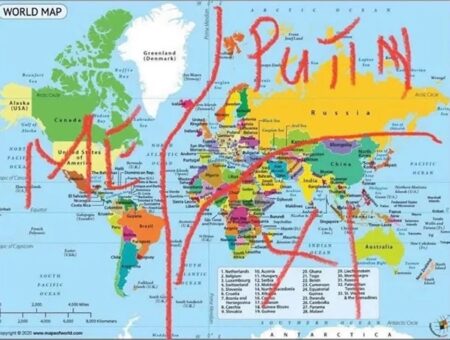
The Russians’ aim is probably to occupy/liberate the Russian-speaking areas, and then install a pro-Russian regime in the remaining parts. They view the whole of Ukraine as part of the Russian sphere of influence. Much in the same way that Greenland, Mexico and Venezuela form part of the American sphere of influence. I note that the mainstream media still rarely speak in terms of spheres of influence, apart from the American one, of course.
Coming to the conclusion that other countries, outside the Western alliances, also have spheres of interest and safeguard them, is usually associated with being a ‘Putin-hugger’, a ‘Vatnik’, a ‘Commie, an ‘anti-democrat’ and so on. The fact that the US extends its sphere of interest all the way to Iran, Korea and Taiwan is seen as a necessary evil. Then, of course, we have a country in the Middle East which, relative to its size, has a truly enormous sphere of interest. And that, too, is considered compatible with the Western liberal order.
And perhaps the justification of spheres of influence is, ultimately, a moral question? Those who are deemed to be in the right in global conflicts and hold the moral high ground also have the right to expand their spheres of influence. The spread of democratic values has, after all, served as such a springboard, and thus the West has had the right – or, indeed, a duty – to interfere in the affairs of other undemocratic countries across the globe.
But surely that’s a good system? Surely those who are righteous should be allowed to exert pressure on those who are not?
The world has changed. These days, few regard the US as thoroughly democratic and virtuous. Money, donations and foul play cloud the democratic playing field. The business sector – such as the defence industry and oil companies – is considered to have a great deal of influence over politics, as does the new economy, spearheaded by AI prophets and technology firms. Similar things are happening in Europe, which is governed by a bunch of unelected political hacks. In short, we are no longer the best representatives of Western democracy. We have no moral high ground. And that makes it difficult to defend a sphere of influence that stretches to the other side of the globe. Nor can we demand that the Russians and the Chinese relinquish their borders of power.