'/%3E%3C/svg%3E)
 When we define politics today, it’s all about enacting laws, creating new regulations and mandates – often rather irritating measures that gradually make life harder for citizens, such as increased bureaucracy, higher taxes and, of course, surveillance; that’s the sort of thing politicians like.
These unpopular measures are rarely mentioned during election campaigns; instead, they are introduced hastily and presented as something important and necessary, or as a means of protecting children and other vulnerable groups. Yet these are the very groups that are completely ignored when it comes to unrest on the streets and in public spaces – which is also a result of political decisions.
Politics, therefore, is about reshaping society in a particular direction, and legislation is constantly accelerating. Those who wish to halt or reverse these trends are often labelled as conservatives or reactionaries. Yet these changes are by no means necessary, nor are they the result of greater insight. As we have already mentioned, this movement is often somewhat pathetic, ill-conceived and almost always benefits our politicians, their privileges and their wallets. And note that the phenomenon goes beyond what we usually refer to as the left or the right.
It has not always been this way; historically, politics has often been about major issues: relations between countries, diplomacy, trade routes, customs duties and taxes. Regional legislation and bureaucracy have not been of equal interest to those in power; as long as the common people behave themselves, there is no reason to monitor or impose meaningless rules on their lives. Admittedly, there have been rigorous rules regarding taxes and how to conduct business, but these almost always boiled down to the actual monitoring of transactions – ensuring that people paid their taxes and did not sell their crops outside the market and on market days – so that the tax collector could get his hands on their hard-earned money.
Otherwise, people were largely left to their own devices. This was particularly true of those living on the outskirts of towns and villages, who fended for themselves and made use of fields, lakes and forests.
Apart from war and peace, politics could revolve around grand infrastructure projects, such as connecting the country via canals, railways, bridges, roads, ports or telegraph lines. All of this, moreover, indirectly benefited citizens: as transport increased, so did the supply of goods and services, which created general prosperity. The Western world experienced a period of strong economic liberalisation between 1870 and 1970, during the so-called laissez-faire period, and social development was in full swing.
These two different political orientations differ markedly. On the one hand, there are those who wish to interfere in every detail, large and small, and use the democratic decision-making process as a pretext to influence our lives. On the other hand, there is the kind of politics that concentrates primarily on the big picture, the broad outlines, whilst leaving the man in the street largely in peace. The parliament met only a few times a year; MPs had other jobs, and decisions were taken only when absolutely necessary.
The view of politics has changed radically; many of today’s politicians are also progressive activists, and many want to fundamentally transform society. At the same time, these activists are deeply corrupt and are often enticed by gifts from the business community and influential organisations. These gifts often come later, frequently in the form of excessively well-paid consultancy assignments, lecture series or similar.
Activism is perhaps mostly a pretext, a kind of disguise, as the politicians’ intentions are very base and are mainly aimed at enriching themselves and their group. And an ordinary civil servant who is tempted with sums running into millions, parties or entertainment often cannot say no. We can also imagine that incorruptible individuals are subjected to very intense pressure campaigns, both from stakeholders and from their own bribed friends. And if words are not enough, perhaps threats will ultimately make them give in?
In other words, it is not our elected representatives who are steering the political course, but people behind the scenes – we do not know exactly who they are. Bribery, corruption and nepotism are neither new nor progressive; they are older than the walls of Babylon.
The democratic system conceals these corrupt activities relatively well, and those who also control the media can get away with almost anything. However, when the internet became accessible to everyone, the balance of power shifted, and citizens began to understand more and more about what was happening behind the scenes. And we sense a sense of desperation; in recent times, politicians have become increasingly agitated and their political projects are veering towards the absurd.
Our European governments are pumping billions of euros into a war project in Ukraine that is doomed to fail. Instead of seeking a peace agreement at an early stage – something that has been on the table several times, but has been all but sabotaged by our politicians. ‘The Russians are evil,’ they say, but that matters for nothing in the world of politics; the task of elected representatives is to create peace and stability, not to tell fairy tales about the good and the evil. We see that arms companies are doing well on the stock market, and when states buy weapons, taxpayers’ money is being used – and it’s clear to see who the losers are in this game. But instead of admitting they’ve been duped, many taxpayers join the warmongering chorus and shout even louder.
Other shady projects involve mass surveillance online and in everyday life, where major tech companies are greasing the palms of our elected representatives and persuading them to introduce digital currencies, wiretapping, backdoors in our computers and phones, as well as surveillance cameras and overgrown data centres everywhere. This enthusiasm for surveillance will, of course, line the pockets of our elected representatives, just like the hopeless war in the East.
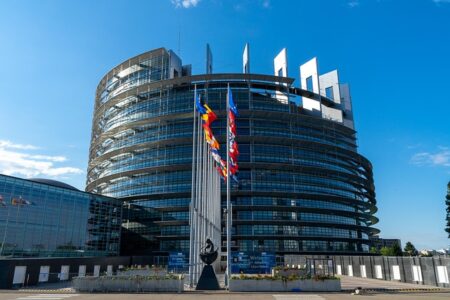
All this whilst our infrastructure is falling into disrepair; power stations are ageing, few new ones are being built, we rarely see new motorway projects, and even high-speed trains have been put on hold – instead, we get cycle paths and congestion charges. The public sphere is under strain; society is torn apart by an endless war of opinions, whilst the Empress in Brussels plays her lyre and watches everything go up in flames.