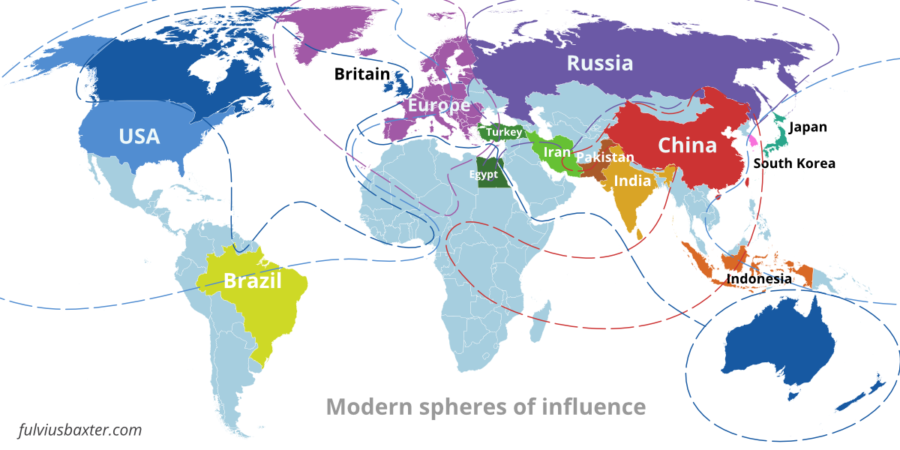
The days of the Cold War are long forgotten, when there were two superpowers dividing the world between them. Today we have several centres of power and distinct spheres of interest, as well as a number of smaller regional powers pressing forward.
The Western World
There is an American bloc, a European one, and a British one. For a long time, we have assumed that they belong to the same sphere of interest, but this is not really the case, as these different regions have divergent geopolitical ambitions. I suspect that this fragmentation will become increasingly apparent in today’s divided world.
The United States
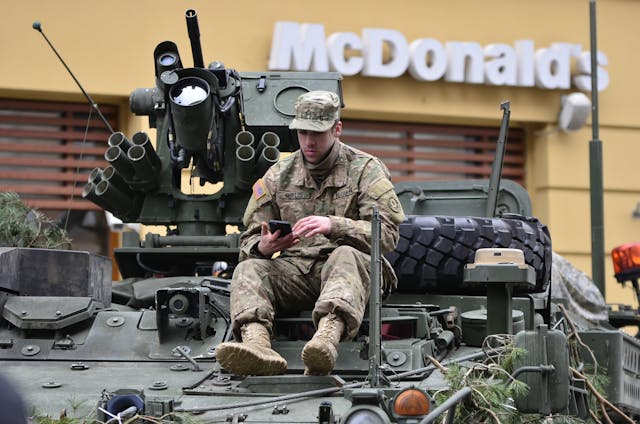
The United States has the Pacific Ocean as its backyard and interests in countries such as Japan, the Philippines, and South Korea. Its sphere of interest also extends deep into South America and across to Europe, to countries such as Germany and Italy, which were the losing parties in the Second World War. The United States is a superpower, and we have learned to accept that it intervenes in world politics in various parts of the globe. This often takes the form of promoting democracy and removing undesirable dictators.
Europe
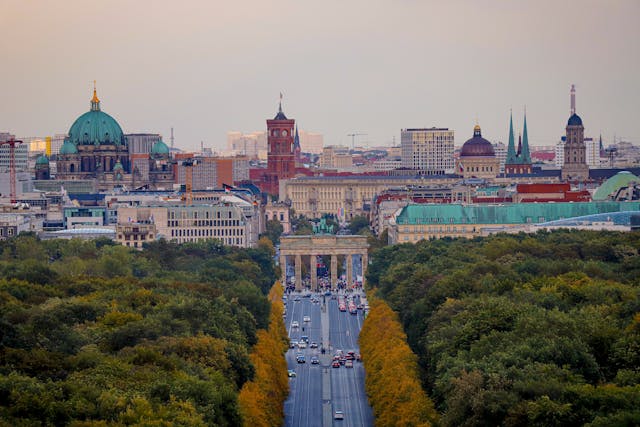
Europe is a fragmented collection of states that, over time, have exercised colonial influence over large parts of the world. It has Russia at its back, and ultimately seeks to establish a peaceful balance with it, preferably through trade in raw materials and agricultural products. A good relationship between Russia and Europe would create a very strong challenger to the other great powers, and therefore the others do everything they can to prevent this.
The United Kingdom
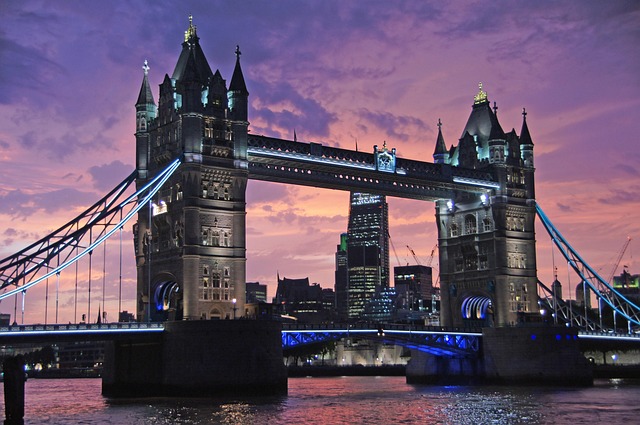
The United Kingdom constitutes a power sphere of its own and exercises influence over Canada, Australia, New Zealand, and a handful of smaller regions around the globe. Together, the Commonwealth has a population of approximately 135 million. Passage through the Mediterranean is important, and there we find Gibraltar, Malta, Cyprus, and the Suez Canal, where the British exercise varying degrees of influence. Since the Commonwealth is spread across several continents and held together by the sea, the British are wary of everything happening around them.
China
China is the great power that has been involved in the fewest wars in modern times. The Chinese have created a global trading empire, and has made major investments in surrounding Asian countries as well as in Africa. Their most important geopolitical sphere is, naturally, the coastline, which faces Japan, Korea, the Philippines, Indonesia, and others. Here they encounter the American sphere of interest, as well as the British one extending down towards Australia. If the Chinese cooperate with the Russians and the Indians, they have their backs covered and can concentrate on the maritime belt and its challenges.
Russia
This vast empire stretches across Europe and Asia, and its sphere of interest primarily points towards the former Soviet republics—Belarus, Ukraine, Kazakhstan, and others. There is also an interest in the polar regions and the natural resources hidden beneath the ice. The Russians prefer stability in Europe, as most attacks on Moscow have originated from there, with the exception of the Mongol invasion during the Middle Ages. Since Russia is positioned between two great powers, China and Europe, it works hard to maintain at least peaceful relations with one of them, in order to avoid a knife in the back. It is also located close to other regional powers such as Turkey, India, and Iran, which makes Russia’s situation unique and its geopolitical efforts difficult, with diplomatic challenges in all directions.
Regional Powers
In South America, there is essentially only one regional power, and that is Brazil. The relationship between the United States and Brazil is important for the stability of the continent.
In Western Asia, we have Turkey, Iran, India, and Pakistan, and this constitutes a true powder keg. Since the region borders both Russia and China, these countries invest considerable effort in maintaining stability there, as unrest in the region could negatively affect them as well.
Japan, South Korea, and now Indonesia are regional powers in a highly charged geopolitical area, namely the East and South China Seas, where both Americans and Britons also exert influence. China will likely work hard to keep the region stable, as conflicts would disrupt its valuable trade.
Alliances
At present, China and Russia are allied. This circle also includes countries such as Iran and North Korea. Within the broader trading community (BRICS), we also find India, Brazil, Egypt, South Africa, Indonesia, and others. In terms of population size as well as cutting-edge technology, the Russian–Chinese side holds an advantage over the Western powers. We have also seen an influx of new participants into this cooperation, while more countries are growing sceptical of the West. There is likely resistance to America’s perpetual wars and to the attitude that it can interfere in other countries’ politics at will.
The United States, the British Commonwealth, and Europe are allied—at least on paper—but various frictions threaten to destabilise the order. Perhaps the war in Ukraine has contributed to unrest within the community, or Trump’s tariff policies, or the feeling of being overtaken by Russia and China? Historically speaking, Western unity is an anomaly—most conflicts, including both world wars, began as internal disputes—perhaps we are returning to a more normal state of affairs?
Fault Lines
One of the obvious fault lines lie along the United States’ sphere of interest in South America, which we can see today in the blockade against Venezuela. There might be unrest in the East and South China Seas, for example the conflict regarding Taiwan. In addition, there is Western Asia and the struggle between the regional powers—Turkey, Egypt, Iran, and Pakistan—where the eye of the storm often turns towards Israel, a state that would be harmless without assistance from the United States and the Western world. Finally, there is the contest in the Arctic and the question of who will control Greenland.